
Freshservice vs ServiceNow comes down to fit, not capability. Freshservice is built for mid-market IT teams that want fast, low-overhead ITSM. ServiceNow is built for large enterprises with dedicated admins and complex governance. Both cover ITIL 4 in full. The right choice depends on your team size, budget, and operating model.
This is not a question of which platform is more capable. It is a question of which platform is the right fit for your team's size, resources, and operational reality. Getting this wrong costs ANZ mid-market organisations hundreds of thousands of dollars and years of adoption problems.
This article compares the two platforms across cost, implementation, automation, AI, and long-term fit. It is written for IT Directors and CIOs at ANZ organisations of 200 to 2,000 employees who are deciding which direction to go.
A disclosure up front: KlickFlow is a Freshworks Premium Partner and runs ITSM platform selection for mid-market teams. That partnership shapes how we deliver, not how we rank. We call out where ServiceNow is the better choice, and for genuine enterprise complexity it is.
TL;DR
- For ANZ mid-market teams of 200 to 2,000 employees, Freshservice vs ServiceNow is a fit decision, not a capability one. Freshservice usually wins on cost, speed and adoption.
- Both cover full ITIL 4. ServiceNow's depth is unmatched at true enterprise scale, but most mid-market teams use a fraction of it.
- Cost: a 15-agent team runs roughly AU$175,000 to AU$350,000 over three years on Freshservice, against AU$750,000 to AU$1.2M on ServiceNow.
- Setup: weeks on Freshservice with a trained admin, versus four to twelve months and certified admins on ServiceNow.
- Choose ServiceNow for enterprise breadth, deep customisation and governance at scale. Otherwise Freshservice.
Not sure which platform fits your team's actual situation? Book a free diagnostic call and we will give you a straight answer in 30 minutes.
Freshservice vs ServiceNow: What Each Platform Is Built For
Both Freshservice and ServiceNow deliver full ITIL 4 coverage including incident management, service request fulfilment, change management, problem management, and CMDB. The difference is not in the practice coverage. It is in who each platform was designed for and what the operational overhead of running it looks like in practice.
Freshservice was built for mid-market IT organisations that want to modernise ITSM without enterprise-level complexity. The emphasis is on fast implementation, accessible configuration, built-in automation, and a user experience that drives adoption without extensive training. Most teams are productive within weeks of go-live, not months.
ServiceNow was built for large enterprise IT organisations with dedicated platform administration teams, complex multi-department workflows, and significant governance requirements. Its depth and extensibility are genuinely unmatched at enterprise scale. However, for organisations that do not need that depth, the complexity and cost become liabilities rather than advantages.
Many ANZ organisations choose ServiceNow for its reputation and then struggle with the complexity. The best platform is the one that matches how your IT organisation actually works, not the one with the most features on a comparison grid.
How the Two Platforms Compare at a Glance
| Area | Freshservice | ServiceNow |
|---|---|---|
| Target market | Mid-market, 50 to 5,000 employees | Enterprise, 2,000+ employees |
| Licence cost | US$19 to US$119 per agent per month (published) | Not published, quote only |
| Setup time | 6 to 12 weeks | 4 to 12 months |
| Admin requirement | Trained IT admin, no certification needed | 1 to 2 certified admins required |
| Customisation | No-code configuration | Deep scripting and custom app development |
| AI capability | Freddy AI, included at Enterprise or a paid add-on on lower tiers | Now Assist, requires Pro or Enterprise plus add-on licensing |
| ITIL 4 coverage | Full, mid-market focus | Full, enterprise modules |
| Self-service portal | Modern, quick to configure | Powerful but complex to set up |
How Much Does Freshservice Cost Compared to ServiceNow?
A word on where these numbers come from, because it matters more here than anywhere else on this page. Freshservice pricing is published by Freshworks and can be verified directly. ServiceNow does not publish pricing at all. Every ServiceNow figure below is KlickFlow's own estimate, built from quotes and contracts we have seen across ANZ mid-market engagements, and your actual quote will differ with negotiation, term length and module scope.
Treat the ServiceNow column as a planning range to test against your own quote, not as a vendor-published rate.
| Cost area | Freshservice (published) | ServiceNow (KlickFlow estimate) |
|---|---|---|
| Licence, per agent per month | US$19 to US$119 | Quote only, typically US$100+ |
| Annual licence, 15-agent team | AU$35,000 to AU$70,000 | AU$180,000 to AU$290,000 |
| Specialist admin and consulting, per year | Minimal | AU$60,000 to AU$120,000 |
| Three-year total, 15-agent team | AU$175,000 to AU$350,000 | AU$750,000 to AU$1,200,000 |
Freshservice pricing accurate as of June 2026. Vendor list prices change, so confirm current rates on the pricing page before you budget.
Total Cost of Ownership: The Three-Year Comparison
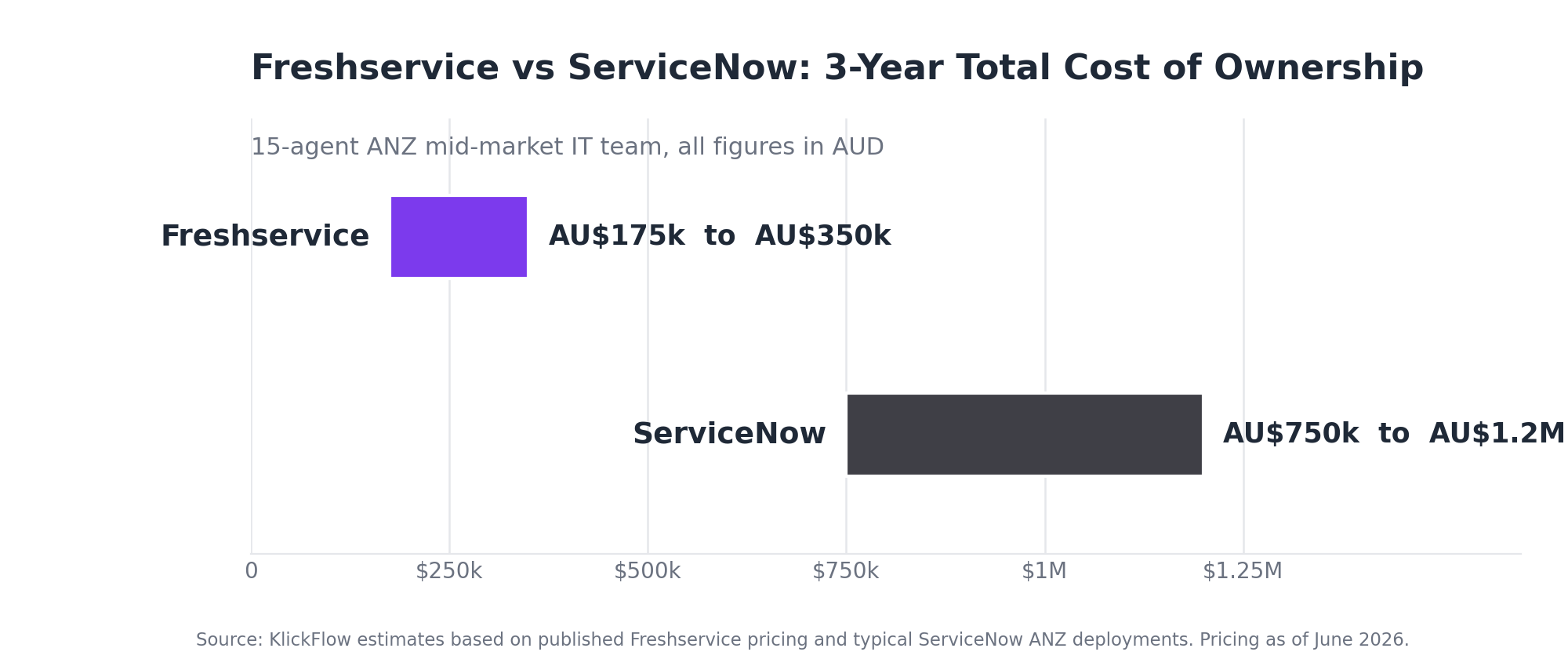
Licence fee comparisons consistently understate the real cost difference. Total cost of ownership for both platforms includes licensing, specialist administration, consulting fees for changes the team cannot make internally, integration maintenance, and the opportunity cost of low adoption when the platform is too complex to use well.
The largest single driver of the gap is not the licence line. It is the certified administrator. A ServiceNow environment that needs a dedicated admin, whether salaried or through a managed service, carries a recurring cost that never appears in a licence comparison and does not scale down when the team is small. That is the number to put in front of your CFO.
For teams using a fraction of ServiceNow's capability, which is common in mid-market deployments, the cost-to-value ratio becomes very difficult to justify. Freshservice delivers the same core ITIL 4 outcomes at substantially lower total cost.
Implementation and Time to Value
Implementation timeline is one of the most practically significant differences between the two platforms for ANZ mid-market teams.
Freshservice implementations for mid-market teams typically take six to twelve weeks from kick-off to go-live. Configuration is handled through a no-code admin interface. Most automation and workflow setup can be completed by a trained IT administrator without external consultants. Teams are typically productive within days of go-live rather than weeks.
ServiceNow implementations for mid-market teams typically take four to twelve months, require specialist ServiceNow developers or certified administrators for configuration, and involve significant customisation to adapt the enterprise-focused platform to a mid-market operating model. Post-go-live, ongoing changes also require specialist involvement, creating a permanent dependency on external resources.
Automation and AI: Accessible vs Advanced
Both platforms have invested significantly in automation and AI capability. The difference is in how much setup is required to activate it and where the AI sits in the pricing structure.
Freshservice's Freddy AI handles automated ticket routing, knowledge article recommendations, self-service resolution, and predictive analytics. According to Freshworks' 2024 benchmark data, teams using AI-powered self-service see ticket deflection rates of 53%. Some Freddy capabilities come with the Enterprise tier and others are a paid Copilot add-on, so confirm what your tier includes rather than assuming AI is bundled. Our Freddy AI review covers what each capability actually does.
ServiceNow's Now Assist delivers comparable AI capability but requires the Pro or Enterprise tier plus additional Now Assist licensing. For teams that need advanced AI across complex multi-system workflows and large-scale intent classification, ServiceNow's AI is more powerful. For mid-market teams whose primary AI need is self-service deflection and routing, Freddy AI delivers equivalent outcomes at significantly lower cost.
Adoption: Where Platform Decisions Are Won or Lost
Adoption is where many ITSM platform comparisons undercount the true cost of the wrong choice. A platform with 40% adoption delivers worse service outcomes than a simpler platform with 90% adoption, regardless of which one has more features.
Freshservice consistently achieves higher adoption in mid-market environments. The interface is intuitive for agents without prior ITSM platform experience, self-service portals are straightforward for end users to navigate, and the configuration language is accessible to team leads and administrators without specialist training.
ServiceNow adoption in mid-market environments is frequently lower than expected. The platform's enterprise-oriented interface and complex configuration often result in agents working around the system via email or Teams rather than through it. This is the pattern most commonly cited by ANZ mid-market teams when they evaluate moving away from ServiceNow.
Where ServiceNow Wins
Enterprise breadth. Deep modules for HR, customer service, security, GRC and finance at scale. For organisations above 5,000 people running cross-departmental workflows, ServiceNow's depth is unmatched.
Deep customisation. Scripting, custom app development and Flow Designer handle any workflow. This is valuable for complex, non-standard requirements.
Enterprise integrations. Native depth with SAP, Oracle, Workday and enterprise security tools via IntegrationHub. More mature than Freshservice at this level.
Advanced CMDB. ServiceGraph Connector and CMDB federation handle thousands of CI relationships across hybrid environments. This is the enterprise standard.
Agentic AI at scale. ServiceNow's Autonomous Workforce and AI Agent Studio are ahead of the market for organisations running autonomous resolution across multiple departments. For genuine enterprise agentic ambition, this is the stronger platform and we will say so.
Where Freshservice Falls Short
Advanced reporting beyond the pre-built dashboards is limited. Complex scripted workflows are not possible in the no-code builder. Enterprise-scale non-IT modules, such as HR case management, security operations and GRC, are less capable than ServiceNow. The per-agent pricing advantage also narrows past 50 agents. For teams that genuinely need these, ServiceNow is the stronger fit.
What the Switch From ServiceNow to Freshservice Looks Like in Practice
Village Roadshow, the iconic Australian entertainment company operating across 37 locations and serving 22 million customers, was on ServiceNow before switching to Freshservice. The platform had become too complex and too expensive for the team's actual operational needs.
Village Roadshow: ServiceNow to Freshservice in six weeks
After switching from ServiceNow to Freshservice, Village Roadshow reported a 60% reduction in ITSM costs annually, on the order of half a million dollars a year. Average ticket resolution time improved by 25%, and customer satisfaction rose by 25%. The full implementation took six weeks. The team moved from a platform they were managing around to one they were managing through. Source: Freshworks customer case study.
Village Roadshow is an ANZ organisation whose experience reflects the pattern we see consistently in mid-market teams: the switch from ServiceNow to Freshservice is not a capability downgrade. It is a right-sizing decision that delivers better operational outcomes at significantly lower cost. A caveat worth stating plainly, since this is a vendor-published case study: six weeks is at the fast end of what we see, and it reflects a team that had already decided what it wanted rather than one designing its operating model from scratch.
Decision Framework: Which Platform Fits Your ANZ Team?
| Choose Freshservice if | Choose ServiceNow if |
|---|---|
| Your team is 200 to 2,000 employees | You operate above 2,000 employees with complex multi-department ESM |
| You want implementation in weeks, not months | You have 4 to 12 months available for implementation and design |
| You do not have certified ServiceNow administrators | You have dedicated platform admin and development resources |
| You want ITSM AI without enterprise-tier licensing | You need advanced AI across complex multi-system workflows at scale |
| Total cost of ownership is a primary consideration | Budget is not a constraint and enterprise governance is required |
| You are using a small fraction of ServiceNow's capability | You are actively using deep ServiceNow customisation and enterprise modules |
Our ITSM Platform Selection service provides a vendor-neutral evaluation framework for teams at this decision point before any commitment is made. For teams that have made the decision and need support with the transition, our ITSM Platform Migration service covers the full ServiceNow to Freshservice process. You can also read our detailed article on ServiceNow to Freshservice migration for ANZ teams for the complete cost comparison, migration process, and timeline, and our guide to why enterprise ITSM tools hurt mid-market teams for the operational signals that indicate a platform has outgrown its team.
Book a free 30-minute diagnostic call. We will give you a clear read on what fits your team and why, on the merits.
Frequently Asked Questions
Is Freshservice better than ServiceNow?
It depends on your size. Freshservice is the better fit for mid-market IT teams that want fast setup, low overhead, and high adoption. ServiceNow is better for large enterprises needing deep customisation, enterprise modules, and governance at scale. Neither is better in the abstract.
Is Freshservice cheaper than ServiceNow?
Yes, for mid-market teams. A 15-agent ANZ team typically pays AU$35,000 to AU$70,000 a year for Freshservice against an estimated AU$180,000 to AU$290,000 for ServiceNow, before ServiceNow's specialist admin and consulting costs. ServiceNow does not publish pricing, so those figures are KlickFlow estimates from ANZ engagements rather than vendor rates. The three-year gap usually runs into the hundreds of thousands, and the certified admin requirement is the largest single driver.
Is ServiceNow worth it for a small IT team?
Usually not. ServiceNow's depth, certified-admin requirement, and four to twelve month setup are hard to justify for a small team that uses a fraction of the platform. Most teams under 2,000 employees get the same ITIL 4 outcomes from Freshservice at far lower cost.
How do we get a realistic ServiceNow quote to compare against?
Ask for the three-year total rather than the year-one licence, and insist that four things appear in writing: the annual uplift percentage at renewal, which modules are included versus add-ons, the implementation partner cost, and the assumed administrator resourcing. Year-one licence pricing is frequently discounted in ways that renewal pricing is not, so a single-year comparison flatters the enterprise option. If the quote does not state the admin assumption, add it yourself at either a salaried certified administrator or a managed service equivalent, because that cost is real whether or not it appears on the vendor's page.
How long does it take to migrate from ServiceNow to Freshservice?
Ten to fourteen weeks for most ANZ mid-market teams. That covers audit and scope definition, operating model design, Freshservice configuration, data migration, integration build, testing, and training. Village Roadshow completed their full migration from ServiceNow in six weeks, which is at the fast end. The most common cause of delay is skipping the operating model design phase and going directly to configuration, which produces rework that takes longer than the design phase would have.
What are the signs that a team should switch from ServiceNow to Freshservice?
The clearest signals are: needing a certified specialist for routine configuration changes, using only a fraction of the platform's available capability, total cost growing without proportional improvement in service outcomes, low agent adoption with workarounds via email or messaging apps, and AI features locked behind add-on licensing the team has not yet purchased. If three or more of these apply, the platform is no longer a good fit for the team's size and operating model.